

Florida Window Tint Laws at a Glance
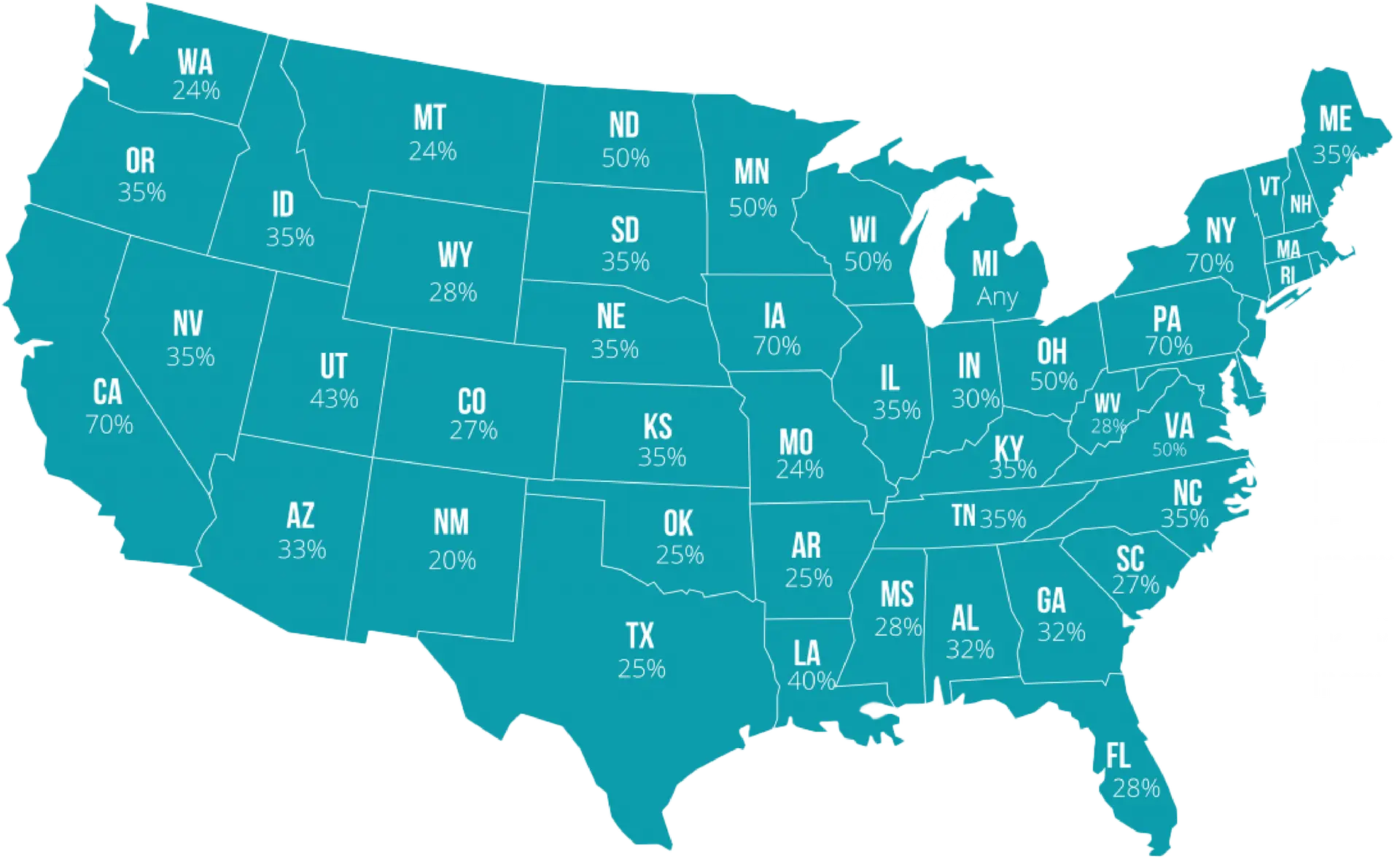
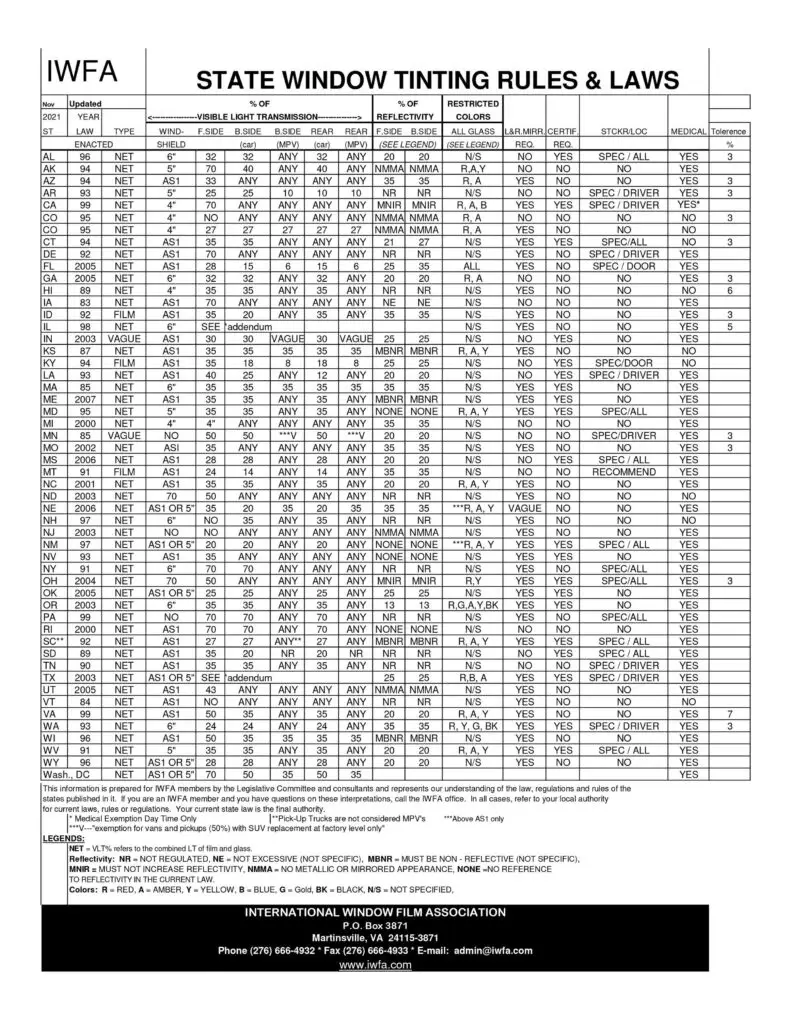
In Florida, the front side windows must let in at least 28% of visible light, and every window behind the driver must let in at least 15% on a car, or at least 6% on a multipurpose passenger vehicle such as most SUVs and vans. Tint is not allowed on the windshield except for a transparent strip at the top, above the AS-1 line, unless the vehicle has a medical exemption certificate. Front side film can be no more than 25% reflective and rear film no more than 35%, and every reading is allowed a tolerance of plus or minus 3%.
| Window | Cars (sedans, coupes, hatchbacks) | Multipurpose passenger vehicles (SUVs, vans) | Statute |
|---|---|---|---|
| Windshield | Transparent strip at the top only, not below the AS-1 line; full windshield only with a medical exemption certificate | Same as cars | § 316.2952(2)(b), § 316.29545(1) |
| Front side windows | At least 28% light in; reflectance 25% or less | Same as cars | § 316.2953 |
| Rear side windows | At least 15% light in; reflectance 35% or less | At least 6% light in; reflectance 35% or less | § 316.2954(1)(a) |
| Rear window | At least 15% light in; reflectance 35% or less | At least 6% light in; reflectance 35% or less | § 316.2954(1)(a) |
| Tolerance | Every percentage is subject to a tolerance of plus or minus 3% | § 316.2955(2) | |
| Medical exemption | Available by FLHSMV certificate for lupus, other autoimmune diseases and conditions that require limited light exposure | § 316.29545 | |
"Light in" is visible light transmittance (VLT), measured through the glass and film together on your specific vehicle. Checked against the 2026 Florida Statutes on October 29, 2026.
What Florida's Tint Percentages Mean
A tint percentage is the share of visible light that gets through the window. Florida calls it transmittance: the percentage of light that passes through the film and the glass together, compared with the light that hits it. A lower number means a darker window, so 15% tint is darker than 28%, and 5% is darker still.
The law measures the finished window, not the film on its own. Florida's limits apply "when applied to and tested on the glass" of your specific vehicle, so a film labeled 28% can read darker once it sits on glass that already blocks some light. The number on the box is a starting point; the reading on your car is what the law looks at.
Reflectance is the other number in the law. It is the percentage of light that bounces off the window instead of passing through, which is what makes some films look mirrored. Florida caps it at 25% on the front side windows and 35% on the windows behind the driver, measured on the non-film side.
Every percentage in the tint law carries a tolerance of plus or minus 3% (§ 316.2955(2)). The state approves the light-transmittance meters used for these measurements, and a reading from an approved device is presumed accurate in court (§ 316.2955(3)).
Is 5%, 15%, 20% or 35% Tint Legal in Florida?
It depends on which window and what kind of vehicle. On a car, anything that measures at least 28% is legal on the front side windows, and anything that measures at least 15% is legal behind the driver. On a multipurpose passenger vehicle, the windows behind the driver can go as dark as 6%. The windshield is a separate rule (see below).
| Window measures | Front side windows (any vehicle) | Rear side + rear window (car) | Rear side + rear window (SUV, van) |
|---|---|---|---|
| 5% | Not legal | Not legal | Not legal (minimum is 6%) |
| 15% | Not legal | Legal | Legal |
| 20% | Not legal | Legal | Legal |
| 28% | Legal | Legal | Legal |
| 35% and lighter | Legal | Legal | Legal |
Reflectance limits apply on top of these: 25% or less on the front side windows, 35% or less behind the driver. Sources: § 316.2953, § 316.2954.
Windshield Tint and the AS-1 Line
Without a medical exemption, Florida does not allow tint on the windshield itself. The only sunscreening material the law permits is a strip along the top that is transparent and does not come down into the driver's direct forward view, which Federal Motor Vehicle Safety Standard No. 205 defines as the AS-1 portion of the windshield (§ 316.2952(2)(b)).
The other things allowed on a windshield are papers required by law, a toll transponder issued by a government entity, and GPS devices. A medical exemption certificate is the only way to go beyond the top strip.
SUVs, Trucks and Vans: the 6% Rule
The darker 6% limit behind the driver applies to "multipurpose passenger vehicles." Florida defines that as a motor vehicle designed to carry 10 people or fewer that is built either on a truck chassis or with special features for occasional off-road use (§ 316.2951(2)).
That description fits most SUVs and many vans. The front side windows and windshield follow the same rules as a car no matter what you drive. If you are unsure which category your vehicle falls in, ask us before you choose a shade.
We also install clear heat-rejecting film on the full windshield, which Florida allows when the vehicle has a medical exemption certificate (§ 316.29545(1)). For everyone else, windshield rules are stricter than side windows in Florida, so call us at (904) 844-8468 and we'll walk you through your options before you decide.
Reflective, Perforated and Louvered Materials
Mirrored looks are limited: no more than 25% reflectance on the front side windows (§ 316.2953) and no more than 35% behind the driver (§ 316.2954(1)(a)).
Behind the driver, the law also allows perforated material that lets in at least 30% of light with no more than 35% reflectance, louvers that reduce driver visibility by no more than 50%, and privacy curtains or blinds that are open and secured while you drive (§ 316.2954(1)(b)–(d)). If the rear window is made non-transparent, the vehicle must have side mirrors on both sides (§ 316.2954(2)).
Factory Tint, Compliance Labels and Repairs
Tint installed by the vehicle manufacturer is exempt from Florida's limits as long as it complies with Federal Motor Vehicle Safety Standard No. 205 (§ 316.2957). Aftermarket film goes on top of that glass, so the combined reading is what counts.
Every installer must put a non-removable compliance label inside the left door jamb stating that the film meets Florida law, along with the film's trade name and the installer's business name (§ 316.2955(1)). Replacing or repairing film that was legally installed is not a violation (§ 316.2956(2)).
Florida Medical Exemption for Window Tint
Florida issues a medical exemption certificate to people with lupus, any autoimmune disease, or another medical condition that requires limited exposure to light. The certificate allows darker tint than the law otherwise permits on the windshield, side windows and windows behind the driver (§ 316.29545(1)).
How to apply
- Complete form HSMV 83390, Application for Sunscreening Medical Exemption, from the Florida Department of Highway Safety and Motor Vehicles (FLHSMV).
- Have the physician's certification section completed and signed. The form accepts a physician licensed under Chapter 458, 459 or 460, a dermatologist, a physician at a military medical facility, state hospital or federal prison, a nurse practitioner under a physician's protocol, or a physician assistant.
- Include a photocopy of a current Florida driver license or ID card and the fee of $6.50 per vehicle.
- Mail it to the FLHSMV Bureau of Motorist Compliance, 2900 Apalachee Pkwy, Mail Stop 97, Tallahassee, FL 32399.
What the certificate covers
The certificate is issued for a specific vehicle and lists its make, model, year and VIN. It has no expiration date, but it cannot be transferred and becomes void if the vehicle is sold. The person with the medical condition does not have to be the registered owner.
Florida law also exempts law enforcement vehicles used in undercover or canine operations, and exempts vehicles owned or leased by certified process servers and licensed private investigators from the side and rear window limits (§ 316.29545(2)–(3)).
Florida Tint Tickets and Penalties
Driving with tint that breaks Florida's limits is a noncriminal traffic infraction, handled as a nonmoving violation (§ 316.2956(1)). The base civil penalty for a nonmoving violation is $30 (§ 318.18(2)). County court costs and fees are added on top, so the total you pay depends on where you are ticketed.
The rules are stricter for shops. Selling or installing film that violates the law is a second-degree misdemeanor (§ 316.2956(3)), punishable by up to 60 days in jail (§ 775.082(4)(b)) and a fine of up to $500 (§ 775.083(1)(e)). That is why a reputable installer will turn down a request for illegal tint.
Out-of-State Vehicles
Rules can differ for vehicles registered in other states. If your car is registered outside Florida, call us at (904) 844-8468 and we'll talk through your situation before you tint.
Florida Tint Law FAQ
Sources
2026 Florida Statutes, Chapter 316: § 316.2951 (definitions), § 316.2952 (windshields), § 316.2953 (side windows), § 316.2954 (windows behind the driver), § 316.2955 (labels and tolerances), § 316.29545 (medical exemption), § 316.2956 (penalties), § 316.2957 (manufacturer exemption); § 318.18(2) (civil penalty); § 775.082 and § 775.083 (misdemeanor penalties). FLHSMV form HSMV 83390, Rev. 07/25. This page is general information, not legal advice.